
Branding Part II: How to Create a Motivating, Sustainable Brand Positioning / Strategy

By Cynthia Batterman
This article originally appeared in the October 2011 hardcopy-only edition of the AAHP Network News.
Building upon a previous article on the importance of a brand positioning statement, this article takes a deeper dive into creating one for your business and brand. To refresh, a brand positioning statement is a few brief statements that convey what you do for whom to uniquely solve a consumer need; it is essential to have compelling brand positioning to help build a strong, differentiated, and defensible brand.
Brand positioning drives where you want your brand to sit in your marketplace against your competitors. Your brand’s positioning must be based upon consumer, competitor, and internal insights.
Understanding your brand starts with discovery and articulation of the brand’s assets and attributes. Consider that you may be too close to objectively view your brand through the eyes of consumers or retailers. Try to capture the insights from a cross-functional team or even external stakeholders.
Five-Step Exercise
1. Competitor Analysis: Start by simply listing the following:
a. What business are you in?
b. Who are your competitors? Be broad; this could include prescription drugs, over-the-counter drugs, supplements, other natural products, or holistic therapeutic services.
c. What are the unique attributes and benefits of your product and what do consumers derive from using it? Include both functional and emotional benefits.
d. What makes your business different or better from your competitors?
2. SWAT Analysis: List your internal strengths and weaknesses Then list external threats and opportunities. I like to do the same for key competitors to help identify truly differentiated opportunities.
3. Target Audience: Who do your products appeal to the most and, very importantly, what does this group of people need? This description should include demographic as well as psychographic details of your target consumer. Use research and data whenever possible.
4. Attitude and Usage Study: Plot your brand vs. the competitive / consideration set on the key motivating attributes. Be sure to include a broad competitive set. Ideally this data would come from an Attitude and Usage Study, but you can also use focus groups or simply use your best judgment based on discussions with consumers, retailers, and internal assessments. The more quantitative data you have, the better.
As an example, DiGiorno Pizza could have been positioned as an expensive, better-tasting frozen pizza. Due to research on their key benefits verses a broader set of competition (home delivery pizza), the company understood the consumers’ attitudes and needs. This enabled the company to position the brand as the smart, convenient, and lower-cost option to home delivery. DiGiorno Pizza ultimately created a new market space!
Finally, complete a one-page document summarizing your brand positioning. There are many formats for this, but one of my favorites is the following brand pyramid.
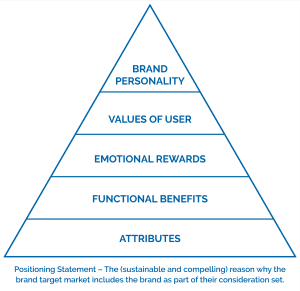
5. Validate Strategy: Last, test your strategy. Is it succinct and focused? Is it differentiated from the competition? Does it accurately describe your competitive advantage? Does it provide a meaningful and compelling picture of your brand/consumer? Can it be used as a filter for brand decision making? Is it aspirational while allowing for future growth?
One of the challenges in developing a brand positioning strategy is trying to include too much. If you find yourself adding six or more adjectives, you may be trying to appeal to too wide of a consumer target. Avoid trying to be all things to all people, which results in being nothing to anyone!
Many businesses will invest a tremendous amount of time and effort to develop their brand position and think they are done, but this is only the beginning. Once your brand positioning strategy is complete, you need to “manage the brand.” Branding should be seen or felt in everything that you (and others within your company) communicate: a new product launch, a package design, your logo, advertising, website, even how you interact with consumers and key stakeholders.
Author: Cynthia Batterman is an executive-level leader, strategist, and executer with a passion for taking businesses to new levels. She has 20+ years of leadership experience in Consumer Good businesses, including global expansion (China, Brazil, EU, Canada, etc.), new products, brand marketing, e-commerce, business development, P&L, and general management. Cynthia served as President, North/South America, for AAHP member company Nelsons (2004–2010) and as Vice President of the AAHP Board (2006–2013).