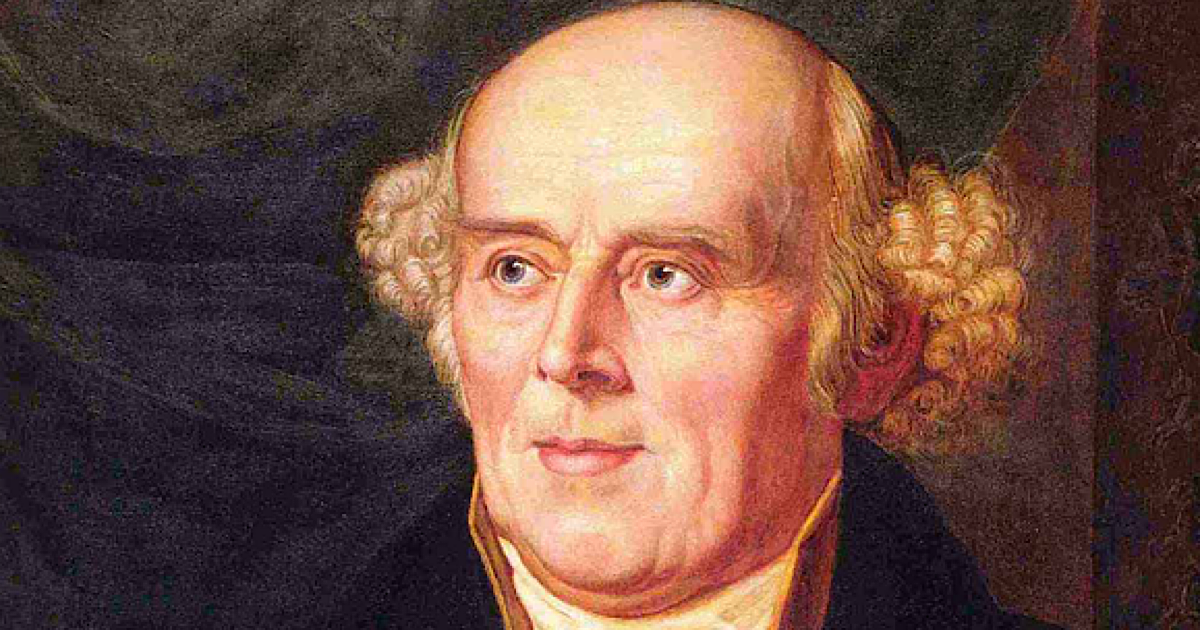
Samuel Christian Friedrich Hahnemann: A Very Brief Biography
By Jay Yasgur, R.Ph. (ret.), M.Sc.
Hahnemann (1755–1843) was born in Meissen, Germany, a locale famous for the production of fine porcelain — his father was a skilled porcelain painter. Hahnemann studied medicine in Vienna and Leipzig before finally earning his medical degree in 1779 from the university in Erlangen.
Early on, he made the acquaintance of Baron von Bruckenthal, serving as his house physician and organizer of the Baron’s collections for three years. While in the Baron’s service, Hahnemann moved to Dessau. There, he fell in love with Johanna Kuchler, the daughter of a pharmacist, who he married in 1782. The couple moved to Dresden where they stayed four years before continuing their peripatetic ways throughout Germany, living in Bad Pyrmont, Pyrmont, Brunswick, Altona, Mollin, Koenigslutter, and several other places before returning to Dessau for another four years. By then, the family consisted of eight children, the eldest being Henrietta.
Why did Hahnemann move so much? It was because of his dissatisfaction with the way medicine was practiced in addition to the constant criticism and harassment that he received from his peers who did not allow him to follow his methodology peacefully.
It was his ever-questioning mind that led Hahnemann to discover the profound method of healing known as homeopathy. After much reflection and research, it was while he translated Dr. William Cullen’s Materia Medica that he discovered (some would say re-discovered) the “like cures like” principle. Here, Cullen indicated that the Peruvian Chinchona bark was effective in treating malaria due to its bitter qualities. Hahnemann doubted this and decided to ingest a small quantity of the bark after which he experienced a fever similar to that of malaria. He pursued this line of inquiry for another six years before his findings were published in Dr. Christian Hufeland’s medical journal in a paper entitled “Essay on a New Principles for Ascertaining the Curative Power of Drugs and Some Examinations of Previous Principles” (1796). It discussed the “likes cures like” principle as well as other important aspects, concluding that “…we must seek medicines that can excite similar symptoms in the healthy human body.” Thus was born the method of inquiry known as proving, one of the central points to understanding homeopathy. Provings is a scientifically applied method of uncovering the medicinal properties of substances that will, when properly prepared, treat disease or act to strengthen the patient’s constitution.
After more intense research and experimentation, Hahnemann published in 1810 his opus, Organon of Rational Healing, which outlined his system in great detail. This landmark book became popular throughout Germany before spreading to many countries, including the United States, where it was introduced in 1825 by Danish physician Hans Burch Gram.
Hahnemann’s sixth and last edition of The Organon was published posthumously in 1921. It consists of numbered aphorisms (paragraphs) covering the entire spectrum of homeopathy’s principles, (proving, dilution and potentization, acquiring a complete anamnesis, the concept of constitution and philosophy of disease, etc.) For instance, in Para. 269, Hahnemann comments on the potentized substances:
“One still hears daily that the homeopathic potencies of the remedies are merely called dilutions, whereas they present the opposite, that is true unlocking of the substances of nature, bringing to light and revealing the specific remedial forces hidden in their inner being. These are accomplished by rubbing and shaking, whereby an un-remedial diluent medium is added as a secondary condition.”
By the time of The Organon’s publication, the family had settled in Torgau, Germany, but soon moved again to Leipzig for eight years. Hahnemann’s ideas were gradually being accepted, his clinical practice was thriving and many doctors came to meet and study with him. Yet still, he could not abide by the continued criticism despite his desire to live and work peacefully. Thus, the family decided to once again move, this time to Kothen (near Dessau). He stayed there for 14 years, during which time his wife died in 1830.
In 1834, Mélanie d’Hervilly, a Parisian artist and aristocrat, came to Kothen seeking relief from her health issues and to learn firsthand about this new healing method. She stayed with Hahnemann for quite some time and, despite a 40 year difference in age, a romance developed. In a few months, they were wed and in 1835 moved to Paris, where Hahnemann would live the rest of his life. He continued his medical practice and, since Mélanie by then had learned the complex and powerful art, the two were sought out by the ill, especially from the affluent segment of society. Mélanie, being well-connected in Paris, introduced her husband to nobility and French culture. Like in Torgau, Hahnemann continued to meet doctors from Europe and across the sea as many came to learn from the master.
Hahnemann died on July 2, 1843, and is now interred at the Père Lachaise Cemetery in the 20 Arrondissement of Paris.
About the Author: Jay Yasgur has been involved with homeopathy since the early 1980s. He was the first in the United States to present a certified continuing education for pharmacists when, in May of 1985, he gave a talk to the Pinellas County Pharmacists Association (PS1-022-085-05; 1.5 ceu), “The Fundamentals of Homeopathy and Macrobiotics.’”' In 1990, he presented a poster concerning homeopathy at the annual American Pharmaceutical Association (APhA) meeting in Washington, DC. His Yasgur's Homeopathic Dictionary is a standard reference in the field. He has written several other works and continues to write articles for homeopathy journals. See www.yasgur.net