
The Hahnemann Monument: Its History and Its Architecture
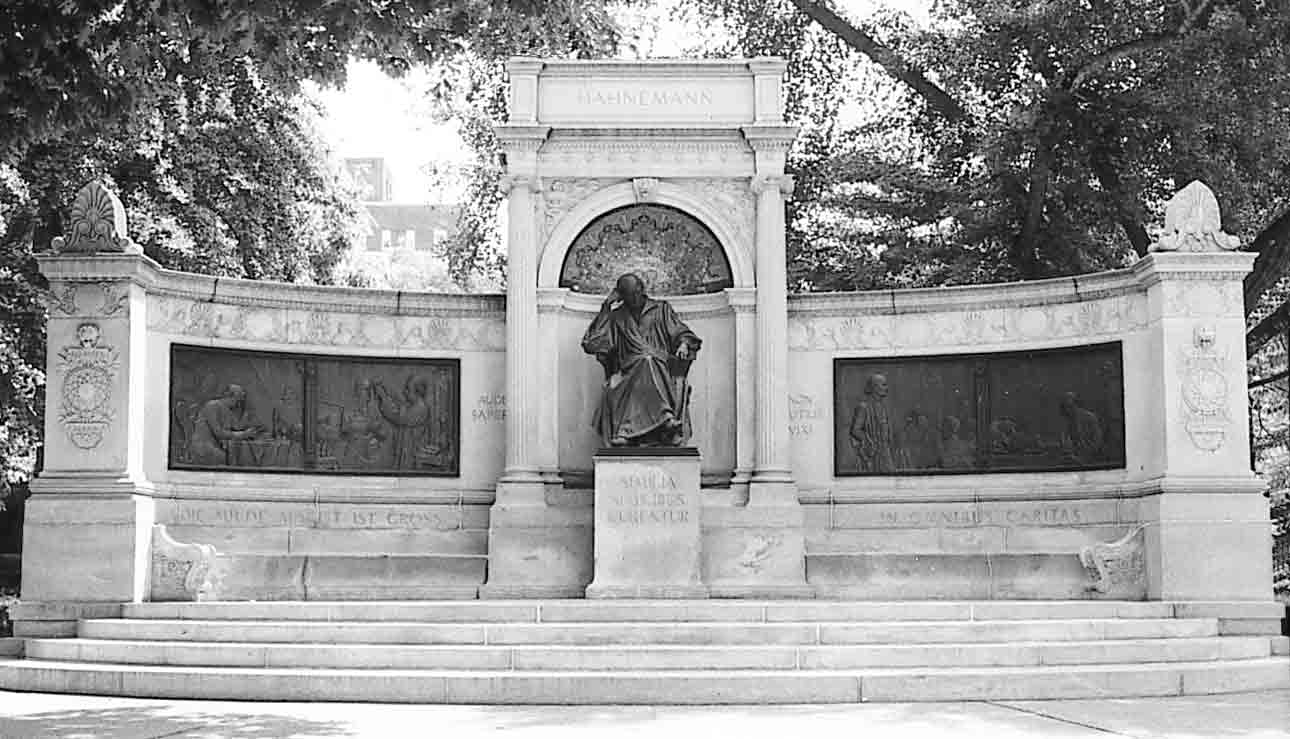
The following is taken from a presentation made in April 2010 at the Samuel Hahnemann Monument in Washington D.C. by Sandra M Chase, MD, DHt, then president of the American Board of Homeotherapeutics (ABHt), and then chairman of the American Institute of Homeopathy’s Hahnemann Monument Preservation Committee. This article originally appeared in the June 2010 hardcopy-only edition of the AAHP Network News.
An early proposal for a memorial to Samuel Hahnemann was made in 1881 by Dr. J.H. McClelland of Pittsburgh, Pennsylvania. This planted the seeds for a second proposal at the 1892 gathering the American Institute of Homeopathy (AIH) in Washington, D.C., leading to an immediate start of fundraising pledges with an estimate of $50,000–$75,000 being needed for the memorial. The project quickly grew from representing 1,400 members of AIH to 12,000 homeopathic physicians in the United States.
The Hahnemann Monument Committee enlisted the aid of the National Sculpture Society to judge a competition to choose a design and sculptor. Invitations were sent to 60 sculptors requesting submission of sketches for a monument containing a heroic bronze statue, “...with a granite pedestal, having such elaboration and accessories as would commemorate Hahnemannʼs life and work”; the invitation stipulated a project costing less than $30,000. Thirty sculptors accepted the invitation, and 24 models were received from American, French, German, Italian, and Spanish sculptors. The models were placed on public display at the American Gallery of Fine Arts in New York City. In 1895, the Committee of the Sculpture Society and the Monument Committee unanimously chose the entry from Charles H. Niehaus of Cincinnati, Ohio. The architect Julius Harder was chosen to design the monument to contain the sculpture.
By the following year, Niehaus had completed a full-size clay model of the sculpture. Eight pieces of the sculpture were displayed in the U.S. Capitol, and a bill passed Congress to authorize a site for the memorial. Scott Circle was chosen partly because it is in a direct line with the White House; however, President Grover Cleveland did not sign the bill into law. Within two years, the granite exedra and pedestal, plus the bronze statue and entablatures were complete. It was not until autumn 1899 that a new bill passed Congress to authorize the site; this was signed by President William McKinley within 24 hours.
The Hahnemann Monument was unveiled and formally dedicated on June 21, 1900. The invited guests included Guest of Honor President McKinley. Attendance also included: Attorney General John W. Griggs; the President of the District Board of Commissioners; the Superintendent of Public Buildings and Grounds; AIH President Dr. Charles E. Walton; AIH Secretary Dr. Eugene H. Porter; Poet of the Day Dr. William Tod Helmuth; Chairman of the AIH Monument Committee Dr. James H. McClelland. Many other homeopathic physicians attended, including Dr. Henry M. Smith, Dr. George G. Shelton, Dr. J. B. Gregg Custis, Dr. Nancy T. Williams. Honor music was provided by the President’s own Marine Corps Band. For an eyewitness report of the 1900 unveiling, see http://www.homeoint.org/books4/washington/unveiling.htm
100 Years Later
A festive rededication ceremony took place on June 21, 2000. The afternoon began and ended with stirring music from the Brass Quintet of the Marine Corps Band Uniformed Services Color Guard. Supporting state and regional homeopathic societies included those from California, Illinois, New York, Ohio, Pennsylvania, and the Southern Homeopathic Medical Association. Participating organizations included AAHP, AVH, AHPA, HANP, HNA, HPCUS, HRN, NCH, NASH, CHC, and CHE. Officers, trustees, and members of AIH with homeopathic dignitaries from around the world were all in attendance. A memorable part of the rededication ceremony was Dr. Nick Nossaman’s reading of Dr. Helmuth’s Ode to Hahnemann, the 21-stanza poem recited by the Poet of the Day at the original unveiling. AIH hosted “Homeopathy 2000—Celebration and Rededication Conference.”
Restoration fundraising began in the summer of 2000; by October 2003 more than $30,000 had been raised; by contrast, the entire original cost of the monument was $48,000 (more than $1,220,000 in 2009 dollars)! The 2000 restoration included restoring the gold-leaf, backed-colored glass tesserae of the arch, cleaning the bronze pieces, cleaning and re-pointing the granite, and re-laying the steps and plaza.
Visit the Monument for More History than is Immediately Apparent
Sculpture
- The central portion is composed of four columns, with Hahnemann seated in front, above whom arises an attica bearing his name.
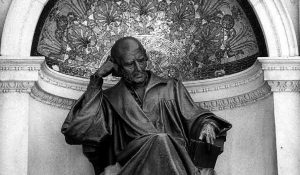
- The head of the sculpture was modeled from a bust in life given by his widow, Mélanie, to one of the American homeopathic colleges.
- Hahnemann is dressed in a timeless robe of a scholar so the statue is not dated by any fashion or style.
- The sculptor’s signature is at the base of the statue.
Latin Phrases Associated with Hahnemann
- SIMILIA SIMILIBUS CURENTUR (Let likes cure likes) is found on the pedestal under the statue.
- AUDE SAPERE (Dare to discern) is found to the left of the statue.
- IN OMNIBUS CARITAS (In all things charity) is found on the right curved wall.
- DIE MILDE MACHT IST GROSS (The gentle action is powerful) is found on the left curved wall, which according to historian Julian Winston, is attributed to Hering, circa 1845.
Symbolism
- Behind and above the bronze statue of Hahnemann is an elliptical niche with an Italian glass mosaic stylistically depicting the foliage and flower of Cinchona.
- There are three lion heads (symbol of strength) sculpted in the granite on the front: one above the head of Hahnemann and two on the rear.
- Upper right portion of niche is decorated with lamp and book, typifying knowledge and instruction (with laurel).
- Upper left portion of niche is decorated with bowl and serpent, symbolizing wisdom (with palm branch).
Entablatures
- The right bronze entablature has two scenes: night vigils of the student (1775–1777) and investigations of the chemist (1779–1789).
- The left bronze entablature has two more scenes: self-experimentation and teaching (1790, Cinchona) and successful treatment of typhus patients at Leipzig (1813).
- The figures in the entablatures depict disciples of Hahnemann: Dunham, Gross, Hartman, Hering, and Stapf.
Back of the Monument
- The main lines of the central portion repeat on the back. The niche is replaced by a flat curtain wall with decoration above: MCM (1900), which is the year of dedication and two figures representing the Art and Science of Medicine.
- The tablet on the curtain wall reads: Christian Friedrich Samuel Hahnemann, Doctor of Medicine, Hofrath [an honorary title meaning Counselor to the Court], Leader of the Great Medical Reformation of the Nineteenth Century, Founder of the Homœopathic School.
- On the rear of the right wall is an inscription of birth date and place encircled with laurel leaves.
- On the rear of the left wall is an inscription of death date and place encircled with laurel leaves.
- Four more city names are inscribed on rear: Erlangen, where he obtained his medical degree; Dessau, where he began his chemistry studies; Leipzig, where he successfully treated typhus patients; and Coethen, where he wrote Chronic Diseases.
Accolades
- The model of this monument won the Gold Medal at the Pan American Exposition and was shown at the 1903 Louisiana Purchase Exposition.
- The National Cyclopedia of American Biography states: “... the statue of Hahnemann… [is] considered the most effective seated statue ever produced.”
Other
- The base courses of the curving granite walls form seats.
- The donor list is secreted somewhere in the monument.
—Photos by Eric L. Foxman, R.Ph.