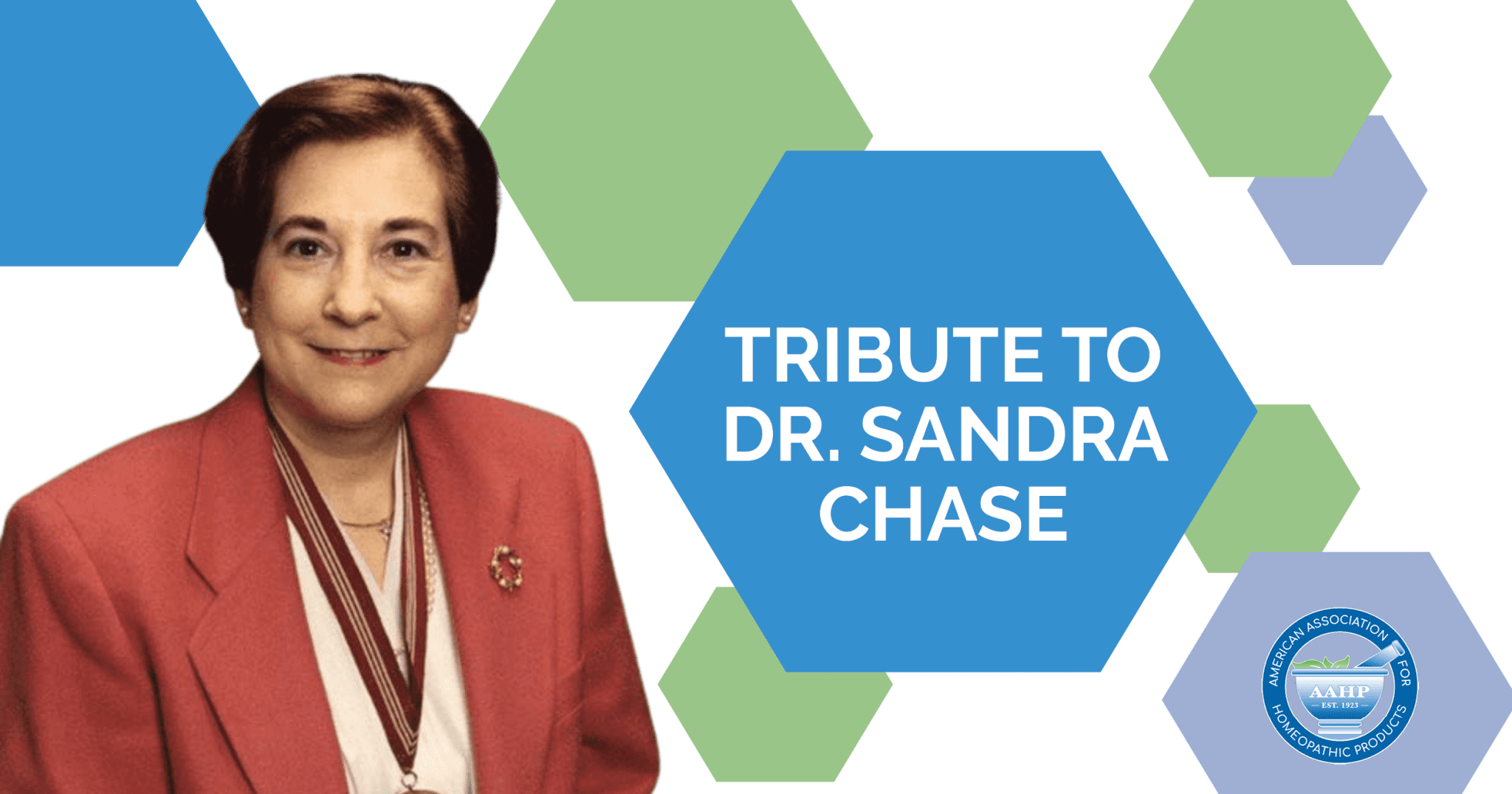
Tribute to Sandra M. Chase, M.D., DABHM
By William Shevin, M.D., DABHM
Dr. Chase joined the Homeopathic Pharmacopeia of the United States (HPCUS) in 1981 and retired on April 22, 2026 after serving for the last 40 years on its Board of Directors. But, interestingly and uniquely, she had previous experience with the Homeopathic Pharmacopeia of the United States (HPUS) itself.
After graduating from Woman’s Medical College of Medicine in 1971, then completing a family practice internship and residency programs through the Medical College of Virginia (Virginia Commonwealth University) in 1974, she enrolled in one of the earliest National Center for Homeopathy summer programs for aspiring homeopathic physicians in Millersville, Pennsylvania. Ruth Rogers, M.D., a member of the American Institute of Homeopathy (AIH), served as the instructor. Dr. Rogers also served on the AIH Committee responsible for publishing the HPUS. The two became friends during the summer program; Dr. Chase then joined the AIH in 1974 and worked with the publications committee. After the HPCUS was incorporated separately from AIH, Dr. Chase was recruited by its first President, Wyrth Post Baker, M.D. She became an associate member of the Convention in 1981 and an Active Member in 1982. She was elected to the Board of Directors in 1986, became its Secretary, and later the first Vice President.
Dr. Chase’s involvement with homeopathy began much earlier. Her father, John, at age 12 had recurrent tonsillitis. Unable to find help through conventional medicine, his mother took him to the distinguished homeopathic physician Julia Minerva Green, M.D., who effected a cure. When John E. Chase married Julia Dobromilska in 1944, it was understood that homeopathy was to be the family’s preferred modality of care.
While researching this tribute, Dr. Chase told me that “when I have been asked at various times within the homeopathic community how did I come into homeopathy, I have answered that I am the only one among my American homeopathic colleagues who came into homeopathy head first. My mother was delivered of me by the distinguished homeopathic obstetrician, J.B. Gregg Custis, on referral from Dr. Julia Green, at National Homeopathic Hospital in Washington D.C.”
In addition to running a successful and exclusively classical homeopathic practice from the late 1970s until 2020, Dr. Chase has been involved in a multitude of organizations and activities. I asked her why she chose to do so. Her answer: “It was important.” Such a clear, basic, and natural statement had to reflect a deep commitment to homeopathy as a healing art. She elaborated, noting the need for continued access to homeopathy for people and a desire to see homeopathy recognized as a medical specialty. She also felt it was important to integrate American homeopathy into the much more active international community. She also wanted homeopathy to gain respect as an empirical science. Her commitment to these ideals led to the following outstanding list of accomplishments and awards:
Homeopathic Pharmacopeia Convention of the United States
- Board of Director, 1986–2026
- Recipient, Service to Homeopathy Award, April 2012
Liga Medicorum Homeopathica Internationalis
- President, 1995–1998
- Former Prime Vice President
- Former member, Executive Committee
- Member, Council of Past Presidents
- Former General Secretary for Public Relations
- General Secretary for the Newsletter, 1998–2013
- Former Editor (and Founder), The Liga Letter, the annual newsletter of the Liga
- President of Honor, October 2004–
- Recipient, Certificate of Special Appreciation, June 2013
- Recipient, Silver Replica Seal
- Recipient, Gold Medallion, 2003
- National Vice President for the USA to LMHI, (organized the AIH-hosted 1987 Liga Congress in Washington, D.C.)
American Institute of Homeopathy
- Former member, Board of Trustee
- President, 1997–2000
- Recipient, Samuel Hahnemann Award, December 2, 2020
- Recipient, James Tyler Kent Award for Outstanding Service to the Homeopathic Community, November 1987
- Chairman, Hahnemann Monument Preservation Committee, 2000–Present
- President, AIH Foundation
National Center for Homeopathy
- Former President
- Former Director of Publications
- Recipient, Henry N. Williams, MD, DHt, Professional Service Award, April 2004
American Board of Homeopathic Medicine
- President, 2009–2011
- Diplomate, 1983
In addition to the list above, Dr. Chase single-handedly reconstituted the Southern Homeopathic Medical Association. She created and wrote its newsletter, “The Southern Letter,” distributed with “The Hahnemannian,” the newsletter of the Homeopathic Medical Society of the State of Pennsylvania. These linkages led to further collaboration with the Homeopathic Medical Society of the State of Ohio.
One of Dr. Chase’s proudest achievements was the rededication and subsequent restoration of the Hahnemann Monument in our nation’s capital, the only one dedicated to a physician. The process began in 2000, 100 years after its original installation. Under Dr. Chase’s leadership, 11 homeopathy organizations and six state and regional associations came together, as well as members of the public, domestically and internationally. AIH raised the needed sums privately to initiate the restoration work and managed the project in public/private partnership with the National Park Service, Central Division. All told, the project took four years. A much more complete description of the monument’s history, significance, and architecture, replete with pictures taken by Dr. Chase, can be found at: https://www.hpus.com/document/the-hahnemann-monument-the-story-of-its-history-and-its-architecture/
The late Nicholas Nossaman, M.D., DABHM, wrote a touching tribute to Dr. Chase that was published in the AJHM 114 Annual 2021. Here, I would like to focus on her service for HPCUS. She took responsibility for homeopathy and the Convention very seriously. She was deliberate, wanting to understand every issue before offering an opinion or casting a vote. She recognized that actions taken by the Convention affected others in the larger community. She understood that the Convention served homeopathy by setting standards and publishing guidelines for the medicines, so that when a sick patient was treated with an appropriately similar medication, healing would occur. She was adamant that our publications were clear and presented professionally. Her “pace” was careful and deliberative. She knew the Convention’s procedures and bylaws and was not shy about reminding us of them when the need arose.
Dr. Chase’s commitment to homeopathy and the breadth of her experience are assets we are sad to lose. We remain committed to the ideals that she worked so hard to realize and wish her the best on her life journey.