
Safety of Homeopathic Products

By Todd Hoover, M.D., DHT
Safety of homeopathic medicines may be considered as part of the entire toxicology spectrum of any starting material. Let us take for example the commonly used homeopathic drug— Chamomilla. It is often selected for use homeopathically to address symptoms like difficulty teething, ear pain that causes intense irritability, restlessness, capricious behavior, a red cheek on one side, and greenish diarrhea. Used in the gross form of the starting material (the whole chamomile plant), such as when making chamomile tea, the effects tend to be soothing and calming so it is frequently used to help people sleep or calm down at the end of the day.
As one increases the daily dosage of chamomile in gross form, more and more people will be affected by the medicinal effects of the substance. Initially the calming effects will prevail, but eventually the toxic effects of chamomile such as nausea, irritability, and restlessness will develop. (If you feel healthy and adventurous you can experiment on yourself, but it takes about 10 cups or so of tea to begin to produce the symptoms). When used in attenuated form as a homeopathic medicine, one observes that at low attenuations many subjects develop some reactions (both desirable and noxious), but they tend to be of mild, nonspecific, and very transient nature. As the attenuation (and thereby dilution) increases, fewer subjects will react one way or another, but those that do are assumed to be more sensitive to the substance. For this reason, attenuations in a relatively low range of 6X to 12C are considered optimal for provings where symptoms are likely to be produced in some of the provers, but the effects tend to be mild and transient. At high attenuations beyond say 30C, very few people will react at all to the substance, but those that do can have a deep effect especially upon pathological processes in the body.
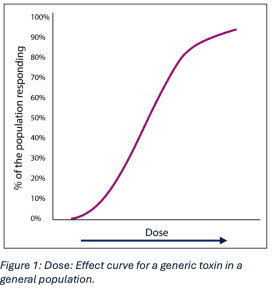 The sensitivity and reactivity of individuals to a substance may be thought of as a relatively straight- line graph (Figure 1). As dose increases, more and more people will be affected. The effects may be initially medicinal (with herbal substances) becoming toxic with increased dose, or the effects may be toxic from the outset (as in the case of poisons like white arsenic).
But this straight line effect graph is not the whole story. The study of toxins like DDT have revealed an unusual effect that has been termed hormesis 1. The notion that less and less of a toxic substance is increasingly less detrimental is true until you reach very small amounts (similar to homeopathically prepared medicines). This results in a “J” curve at the lowest concentrations where health is better and better with less exposure until the inflection point at very low concentrations, which demonstrates that it is actually adaptive or healthier to have some exposure to the toxin (see the graph in Figure 2)2. This inflection may represent some stress-adaptive effects caused by exposure to minute amounts of toxic substances.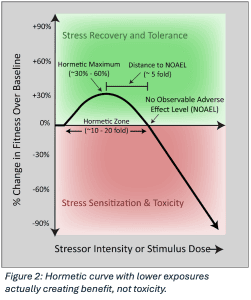
Since many homeopathic substances begin as somewhat toxic starting materials, including chemicals, plant materials, and poisons derived from animals, manufacturers are well-advised to keep current on safety and toxicology information as it develops in the scientific literature for any substances used in their products. For example, several starting materials use Aristolochia species. The first toxicological reports on these plants described nephrotoxicity in rabbits in the second half of the nineteenth century. But it was not until 1993 that the Lancet reported the use of weight loss remedies contaminated with these plants was linked to a rapid and progressive renal fibrosis in more than 100 women in Belgium. Subsequently, an article in the New England Journal of Medicine (NEJM) linked a number of these cases to the development of urothelial cancer, which led FDA to issue safety alerts for these plant compounds. In response to these findings,the Homeopathic Pharmacopeia of the United States (HPUS) updated the Lowest Permissible Attenuations (LPA) for monographs of substances containing aristolochic acid, including Aristolochia clematis (Birthwort), Aristolochia serpentaria (Virginia Snakeroot), and Aristolochia milhomens (Boat-flowered Dutchman’s Pipe). For these three, the LPA for OTC use was recommended at 12X due to the carcinogenic and idiosyncratic nature of the toxicity that was evident in the literature review by the HPCUS Toxicology and Safety Committee.
The HPUS recommends LPAs for OTC, Rx, HPN, and sometimes topical use 3. The HPCUS Toxicology and Safety Committee meets throughout each year to review and update monograph recommendations for LPAs as they become aware of new safety information and as part of periodic reviews. Manufacturers are encouraged to track potential adverse events and do periodic reviews of all safety and surveillance reports for their products. As a manufacturer, if you become aware of a potentially new safety concern, please file a report with HPCUS through the Contact link on the HPUS.com website so that we may investigate the matter and make any necessary updates to the monograph.
Homeopathic practitioners may use homeopathic drugs either as OTC products or as a prescription if they have that authority. While most practitioners expect safe products for OTC use, they may not be aware that lower attenuations are available on an Rx-only basis. While these lower Rx-only attenuations are still considered safe by HPUS, they do not necessarily have the extra safety margin that is added by the HPCUS as a further protection measure for OTC drugs. Manufacturers and distributors of homeopathic drugs would be well served by ensuring practitioners are aware of the inherent differences for Rx-only attenuations.
Dosage form, recommendations for amount used, and frequency of intake vary from manufacturer to manufacturer. At one point in time, most homeopathic drugs were dispensed only as globules or powders. Now, one can find syrups, tablets, lozenges, sprays, topicals, injectables, and other forms. The HPUS recommends LPAs based upon a maximum daily consumption (considered an overdosage of entire package contents) of 1.25 grams of 100% active ingredient per day in their calculations for recommended LPAs. Manufacturers who dispense dosage forms that deliver greater amounts of the active ingredient than listed in the HPUS guidelines for manufacturing must consider any attendant safety compromise that might be created.
Patient and consumer use patterns for homeopathic products have not been well-described in the scientific literature. Anecdotally, the author has witnessed some consumers deviate from package instructions. In one case, a patient took Natrum muriaticum 12C four times daily for thirty days before coming for treatment for a headache. Upon examination, the most likely homeopathic medicine needed for treatment was in fact Natrum muriaticum. The individual was most likely generating a mild proving effect of the drug due to repetitive dosing. By discontinuing the medicine and waiting approximately five days, the individual improved and the now clearer clinical picture of the more appropriate treatment became apparent.
From the author’s observations, most prescribers traditionally have tended to use posology that follows one of several patterns: a) use of one drug at a time, often in 30C or higher attenuation, and generally not repeated for at least six weeks, b) use of frequent dosing of a single drug, often in lower attenuations such as 6X or 6C daily or even more frequently for up to two months, but sometimes interspersed with other selections intermittently, c) use of LM or Q attenuations either by olfaction or orally on a daily or as needed basis, but again usually one medicine at a time. However, some practitioners use multiple remedies simultaneously, changing frequently in both lower and higher attenuations. Recently, there has been a trend to use multiple drugs in high attenuations many times per day in an effort to cure multiple “miasmas” that have been superimposed upon the healthy state of the patient. While the concept of miasma has been well-described by Hahnemann and may to some extent be explained by epigenetic effects upon the underlying genetic limits of the individual, this recent approach to posology has been associated with some potential concerns.
The views, thoughts, and opinions expressed in the following article are solely those of the individual author and do not necessarily reflect the official policy or position of the American Association for Homeopathic Products, or any other individuals or entities associated with the author.
References
1. Calabrese EJ. Hormesis: a revolution in toxicology, risk assessment and medicine. EMBO Rep. 2004 Oct;5 Spec No(Suppl 1):S37–40. doi: 10.1038/sj.embor.7400222. PMID: 15459733; PMCID: PMC1299203.
2. Leak RK, Calabrese EJ, Kozumbo WJ, et al. Enhancing and Extending Biological Performance and Resilience. Dose-Response. 2018;16(3). doi:10.1177/1559325818784501.
3. For more information, see Explanation of the Attenuation Levels Recognized by the HPCUS (accessible by subscription).